

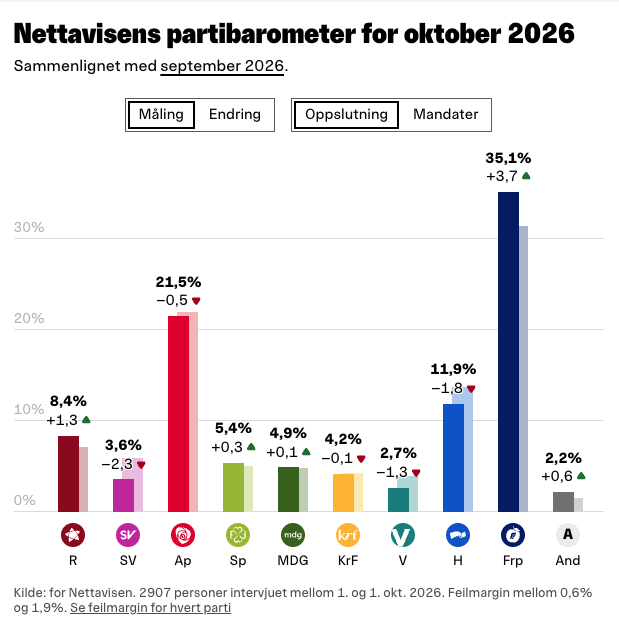
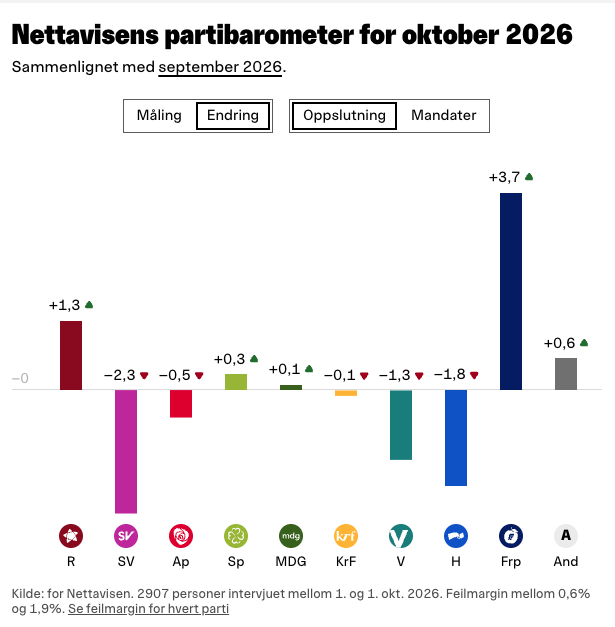
Høyre receives 11.9% in InFact’s October poll for Nettavisen. It is the party’s weakest result in an InFact poll since the polling series began in 2006.
At the same time, the Progress Party (Frp) receives 35.1%. In this poll, Frp is therefore almost three times the size of Høyre.
These are striking numbers. But perhaps the most interesting point is not how far Høyre has fallen or how high Frp has climbed. It is what is happening between the two parties.
Behind the headline figures, there is a significant movement of voters from Høyre to Frp. Around one in four people who voted for Høyre in the previous parliamentary election now say they would vote for Frp.
This tells us something beyond the current standing of two political parties. It also raises a broader question about how the balance of power on the centre-right may be changing.
The poll was conducted by InFact for Nettavisen. Read Nettavisen’s coverage of the results here.
Voters do not necessarily have to switch political sides
When a party loses voters, it is easy to describe this as voters rejecting the party’s politics. But where those voters go is just as interesting as the fact that they leave.
A Høyre voter who moves to Frp has not necessarily switched political sides. That voter may still want a centre-right government but have changed their view of which party best represents their priorities.
That is an important distinction.
Party choice is not simply a matter of where voters place themselves on a traditional left-right spectrum. Voters also consider which issues matter most to them at a given time, which parties they perceive as the clearest in their positions, whom they trust, and which parties they feel are addressing the problems they themselves care about.
When large numbers of voters move between two parties on the same side of the government divide, it may therefore reflect competition over which party gets to define the political direction within that bloc.
Frp has moved from challenger to dominant party
What makes the current situation particularly notable is the size of the gap.
For long periods, Høyre has been by far the largest party on the centre-right and therefore the natural centre of gravity in the competition for government power. In this poll, that relationship has been dramatically reversed.
Frp receives 35.1%, compared with Høyre’s 11.9%.
Nor is this a development that emerged in October alone. In InFact’s polls for Nettavisen, Frp has been above 30% since May. Over the same period, Høyre has remained considerably lower.
This makes it more difficult to regard the gap between the two parties simply as random variation from one poll to the next.
At the same time, we should be careful not to draw conclusions beyond what the figures allow. An opinion poll is a snapshot of what voters say at the time they are asked. It does not tell us that today’s balance of support will remain unchanged until the next election.
But when the same broad pattern appears across several polls, it becomes relevant to ask whether voters’ expectations of the parties may also be changing.

A change of leader does not necessarily change voters’ minds overnight
Ine Eriksen Søreide has taken over a Høyre that was already facing a challenging situation among voters. It would therefore be too simplistic to interpret the 11.9% result as a judgement on her alone.
Party leaders matter, but shifts in voter support rarely have a single explanation.
Political issues, party positioning, media coverage, economic conditions and which issues voters consider most important can all affect party choice. On top of this comes competition between parties seeking the support of many of the same voters.
For Høyre, this becomes particularly important when Frp is performing so strongly.
A voter considering both Høyre and Frp does not necessarily have to be particularly dissatisfied with Høyre in order to switch. It may be enough for Frp to be perceived, at that moment, as the clearer alternative on issues the voter considers important.
This also means that such voter movements are not necessarily permanent.
Behind the percentages is a competition for voters
It is easy to focus on record figures in an opinion poll. Høyre at 11.9% and Frp at 35.1% naturally make for striking headlines.
But the underlying figures tell a more interesting story.
A significant part of the movement is taking place between parties competing for some of the same voters. This means that we are not simply seeing a change in the overall level of support for the centre-right. We may also be seeing a shift in the centre of gravity within it.
That could have political significance well beyond the percentages in a single poll. The relative size of the parties affects which issues receive attention, which compromises become possible and which party has the greatest influence over the direction of a potential governing coalition.
So perhaps the most important question following this poll is not why Høyre receives exactly 11.9%.
The more interesting question is what it would take for voters who have now chosen Frp to choose Høyre again.
Because if these voters remain on the centre-right but have changed which party they believe best represents them, it is not primarily their political alignment that is shifting.
It is the balance of power within the bloc.
Vegard Jarness
PhD, Head of Analysis
vegard@infact.no


