
Immigration policy is one of the most contentious issues in Norwegian politics. The political parties have clearly defined positions, but does the image they wish to project of themselves correspond with how voters actually perceive them? A new opinion poll reveals some interesting differences.
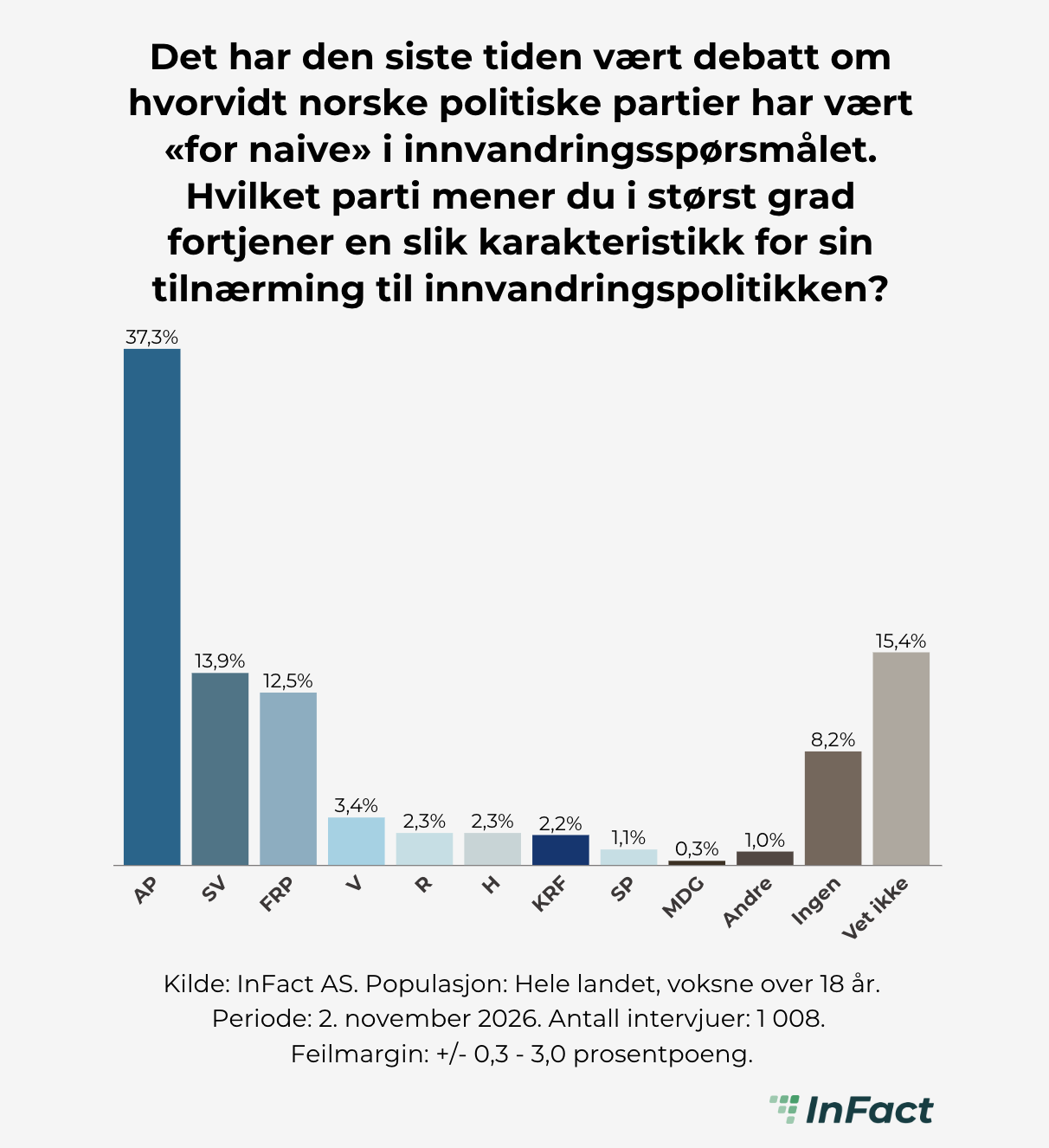
In a survey conducted by InFact for Nettavisen, we have taken as our starting point the recent public debate about whether political parties have been “too naive” on immigration. We therefore asked a representative sample of the Norwegian population which political party they believe most deserves this description.
The results show that 37 percent of respondents believe the Arbeiderpartiet (AP) has been the most naive on immigration. SV receives 14 percent, while FrP comes in third with 12,5 percent.
FrP’s position is particularly interesting. For many years, the party has built a significant part of its political profile around restrictive immigration policies. Nevertheless, a relatively large proportion of respondents believe that FrP has also been too naive.
The results illustrate that voters’ assessments do not necessarily align with the political self-images that parties have of themselves.
Arbeiderpartiet Is Most Strongly Associated with Naivety
The fact that AP receives 37 percent of the responses is not necessarily surprising. As one of the country’s largest political parties, with extensive experience in government, it is also closely associated with political developments across a wide range of areas of society.
When voters are asked to assign responsibility for political developments they are critical of, parties with significant political influence may be particularly exposed. This does not necessarily reflect a detailed assessment of the party’s specific immigration policy decisions. It may also be about which party voters associate with responsibility for the current situation as they perceive it.
FrP Also Faces Criticism
FrP’s third-place position is perhaps the most interesting finding in the survey.
For several decades, the party has established itself as a prominent critic of Norwegian immigration policy and has argued for a stricter approach. The fact that around one in eight respondents nevertheless believe that FrP has been the most naive shows that a clearly defined political profile does not necessarily mean that voters associate the party with their own perception of that policy area.
But how should we interpret this result? There are several possible explanations.
First, the question may have been interpreted as an opportunity to express political opposition. Respondents are asked to identify the party that has been “too naive”. This is a negative characterisation, and not everyone necessarily assesses the question based on a detailed review of the parties’ immigration policies. Some may have used the opportunity to point to the party they disagree with most politically, while others may have chosen the party they associate with an immigration policy they consider too liberal. In that case, the responses capture more than just assessments of the parties’ political positions. They may also reflect general political opposition and ideological distance.
Second, the term “naive” can be understood in several different ways. Some associate it with an overly liberal immigration policy and an excessive belief in integration. Others may focus on the parties having underestimated the challenges associated with immigration, been insufficiently consistent or failed to adequately consider the consequences of their own policies. The term can also be used more generally as a negative characterisation of a party with which one disagrees politically. As a result, voters with very different political views may respond based on entirely different understandings of what it means to be naive.
The fact that both the AP and SV receive relatively high shares is interesting in this context. Both parties can be associated with a more liberal immigration policy, but their respective assessments may have different starting points. AP may be more closely associated with actual political responsibility, while SV’s position may be more closely linked to its principled political positions.
FrP’s result, on the other hand, may reflect opposition to the party’s restrictive approach to immigration policy. For voters who are critical of strict immigration policies, FrP’s approach may also appear naive, but for entirely different reasons than for those who believe immigration policy has been too liberal. For example, they may believe that the party underestimates the complexity of immigration and integration issues, or places too much faith in the idea that stricter measures alone can solve the challenges.
The results therefore do not necessarily reflect one shared understanding of what constitutes a naive immigration policy. Rather, they may reflect different political positions, expectations and perceptions of what constitutes good immigration policy.
The Parties’ Self-Images and Voters’ Perceptions
It is relatively easy to describe political parties based on their official positions and policy proposals. However, to understand where parties stand in public opinion, it is also necessary to examine how they are actually perceived by voters.
The survey shows that AP is by far the party most strongly associated with having been too naive on immigration. At the same time, FrP’s position demonstrates that voters’ assessments do not necessarily follow the traditional divide between restrictive and more liberal immigration policies.
In a political issue as contentious as immigration, these perceptions can be just as interesting as the parties’ official positions.
Read the full news article at Nettavisen here.
Vegard Jarness
PhD, Head of Analysis
vegard@infact.no


